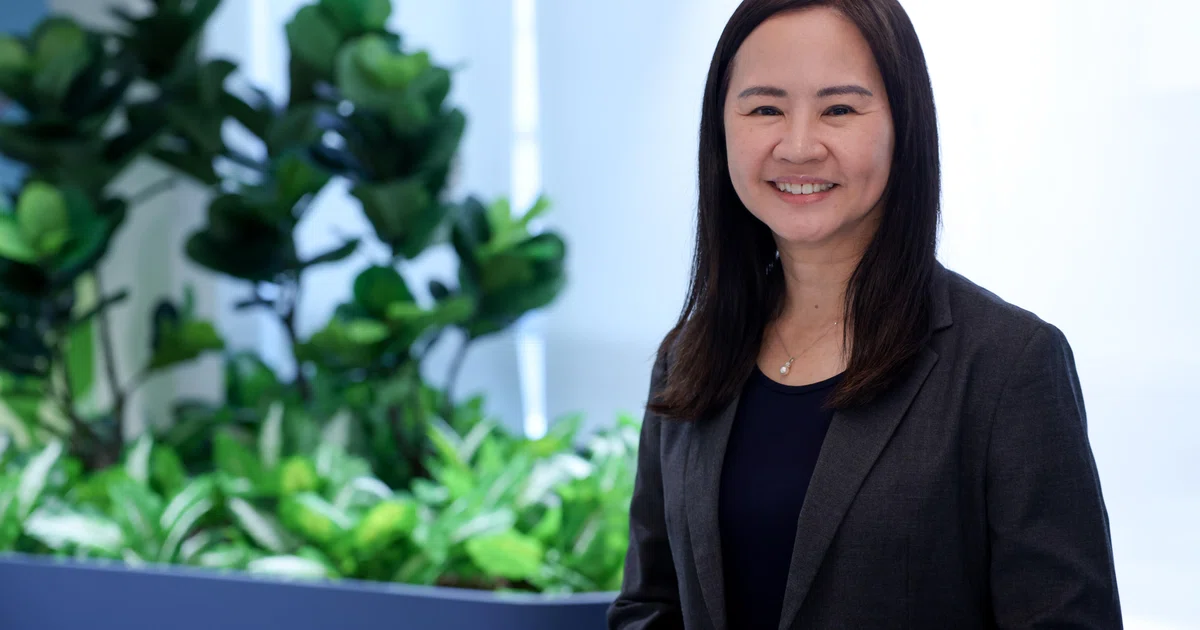
From fashion to aviation: Doris Tan leads Shell’s green jet fuel take-off
Tan believes that green jet fuel is the best bet to decarbonise flying, as Asia gears up for a travel boom
The strategies and stories that shape today’s leaders.
[SINGAPORE] A 28-year veteran of oil major Shell, Doris Tan faces one of her greatest challenges yet: getting airplanes to fly on green fuel.
“To me, the North Star for aviation is very clear: We have to decarbonise in order to grow, if we all still want to fly,” said the general manager of jet-fuel supplier Shell Aviation for the Asia-Pacific and the Middle East.
Aviation accounted for 2.5 per cent of the world’s energy-related emissions in 2023, but the industry wants to achieve net-zero emissions from operations by 2050. Shell aims to hit net zero by the same year.
Sustainable aviation fuel – made from used cooking oil or other renewable feedstock – is the “single most feasible solution we have” to cut emissions from flying, she told The Business Times in an interview at Shell’s Buona Vista office.
Tan, 52, is the first Singaporean to hold her position and had an atypical start to the job. Just as she took on the role in March 2020, Covid-19 brought flying to a standstill, leaving the jet fuel industry in uncertainty.
Navigate Asia in
a new global order
Get the insights delivered to your inbox.
It may have seemed like the worst time possible to lead an aviation fuel business, but she saw a silver lining.
“In hindsight, I think that was the best time to take on the role, because it gave me the time and space to think about what’s next for the business, what’s next for the industry,” she said.
This breathing room catalysed her efforts to bring sustainable aviation fuel into Singapore and other markets.
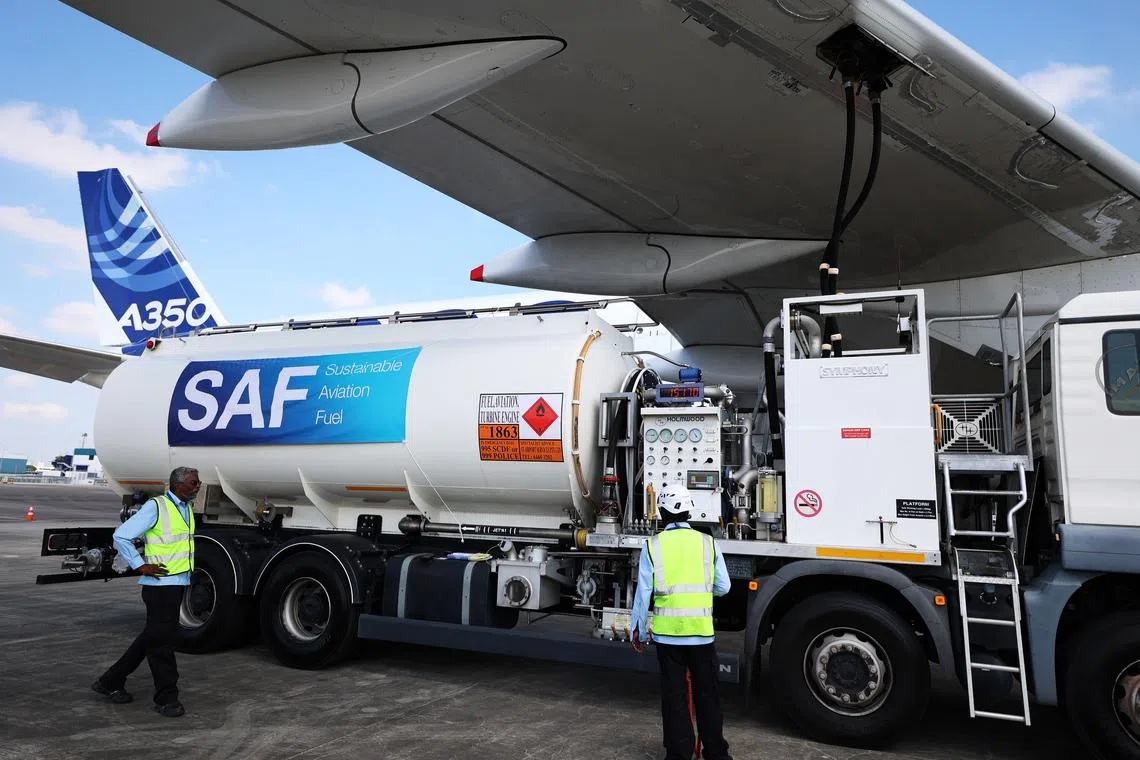
Under her leadership, Shell upgraded its Singapore facility to enable the blending of this type of fuel. In 2022, it became the first supplier of the fuel in Singapore, with shipments to the Republic of Singapore Air Force and Singapore Airlines Engineering Company.
Shell brought sustainable aviation fuel into Hong Kong in 2022, and Dubai the following year. It has supplied the fuel to carriers such as Japan Airlines and Cebu Pacific, and business aviation firms Bombardier and Jet Aviation.
Today, Shell supplies this green fuel in 80 locations across 18 countries.
Strategy in a challenging market
Sustainable aviation fuel costs two to five times more than regular jet fuel, as used cooking oil is challenging to procure. Production methods that tap other raw materials – such as alcohol or waste industrial gases – are still in their infancy, and the output from such sources is even more expensive.
Tan has had to strategise Shell’s role in the supply chain carefully, weighing the investment possibilities against potential returns.
In 2021, Shell started studying the possibility of producing sustainable aviation fuel in Pulau Bukom – where it had a refinery complex – to supply the likes of Changi Airport and the Hong Kong International Airport.
But in 2023, the company decided not to go ahead with the project, in a move guided by the need for “acceptable returns” and maintaining capital discipline, said Tan.
“(It) became clear that the project would be insufficiently competitive across a range of options in our portfolio to meet our customers’ need for affordable, low-carbon products.”
Shell sold its Pulau Bukom assets last year, to pivot to more lucrative businesses in the region.
That said, Tan still sees Shell playing a key role in the sustainable aviation fuel market. “The most critical shortage that we see today is in the infrastructure: the tanks at the airport, the blending facilities, the terminals,” she said.
She believes that Shell strengthening such infrastructure “will help meet growing demand and reduce bottlenecks at airports”.
No stranger to the unknown
Navigating unknown terrain is not new to Tan, who has taken the path less travelled to her current role.
A graduate in retail marketing from the National University of Singapore, she started her career in fashion merchandising. In 1998, she joined Shell to expand its retail kiosks, focusing on the convenience store strategy.
She moved to a consulting role in a McKinsey-style unit within Shell, where she looked into the company’s business in Europe, the US and Russia.
Tan also accumulated experience in other divisions, such as lubricant sales – which included visits to logging and mining sites – as well as commercial fuels.
She cites a willingness to “unlearn and learn again” as being vital. “I’m somebody who has no qualms going to my people to say: ‘I do not know this, please teach me’.”
“Still not enough”
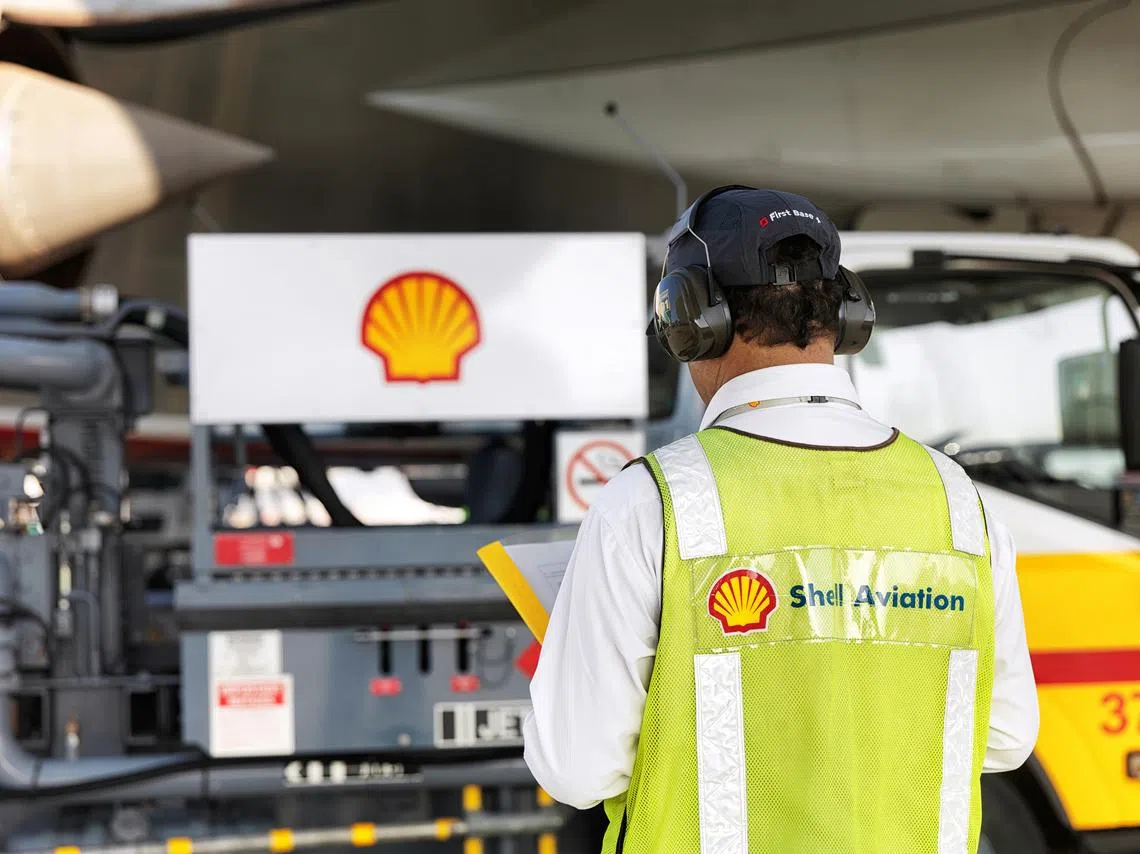
Even with Shell Aviation supplying green jet fuel in 80 locations, Tan deems this figure as “still not enough”, especially with travel demand set to further boom in Asia.
She pointed out that just 17 per cent of Japanese hold passports. The proportion is even lower in other key Asian markets – 11 per cent in China, and 7 per cent in India.
“It means that our part of the world – as wealth increases, as population increases – we are going to really see a very steep increase in aviation growth,” she said.
This comes amid growing support for sustainable aviation fuel from policymakers.
For instance, Singapore aims for the green fuel to account for 1 per cent of all jet fuel used at Changi and Seletar airports in 2026, rising to 3 to 5 per cent by 2030. The Republic has set up a central buyer for sustainable aviation fuel, and introduced a levy for the fuel, ranging from S$1 to S$41.60 for each airline ticket.
Countries such as Malaysia and Japan are also introducing sustainable aviation fuel mandates, a momentum that Tan described as encouraging.
“In the last five years, one thing that I see that is really progressing is the commitment and the actions that are being taken by the governments in the Asian economies,” she said.
Chicken-and-egg quandary
That said, there is also a “chicken-and-egg” quandary: whether a certain amount of demand should be built up first, or if the supply needs to come in first.
Tan’s answer: Both need to be developed concurrently.
She cites corporate demand as a key ingredient which “moves the needle” for sustainable aviation fuel.
“Can you imagine if all corporations in Singapore – DBS, CapitaLand – everybody needs to buy sustainable aviation fuel to offset or compensate for the emissions… of their staff travelling or the goods that they ship all over the world?” Tan asked.
Such corporate demand will “give a very strong signal to oil producers and the whole supply chain’s actors, to build up the infrastructure”, she added.
Shell advocates a “book-and-claim” system, under which companies book a quantity of sustainable aviation fuel to be used on flights, and receive a claim for the emissions reduction.
“If I can do that, what that means is I open up a huge market for people to be able to pay for their Scope 3 (emissions). And that financing is important to the industry,” she said.
Scope 3 emissions refer to those arising from a company’s value chain.
In 2022, Shell launched a digital book-and-claim platform, Avelia, built in collaboration with Accenture and the Energy Web Foundation. There are now 66 corporations and airlines on the platform, which taps blockchain technology to ensure traceability.
This year, Shell opened up Avelia to other sustainable aviation fuel suppliers, acting on feedback from airline companies.
With such efforts gaining traction, Tan sees herself being in the right place. “Asia is where aviation will grow, and because of that, I’m excited to be part of this change that we’re going to see.”
Three questions with Doris Tan, head of Shell Aviation in the Asia-Pacific and the Middle East
Q: Was there a pivotal moment in your career or personal life that changed your approach to leadership?
My leadership style is servanthood. I don’t come from a very typical mould – I’m not a scholar; I started with Shell in 1998 at a fairly low level. But I really put my head down and worked my way up.
Because of my experience coming up from the rank-and-file, I really appreciate people. I believe if I take care of my people, the people will then take care of the business.
One of the things that I’m very particular about is I want to make sure that everybody has a meaningful role… For example, I had a scheduler, but in the whole time he worked for me, I think scheduling was only 20 per cent of (his portfolio).
He had the ambition, the capacity, the desire to do more, so I gave him more. So when he worked with me, he was doing a lot of strategy and optimisation projects for us. He even developed a model for us to allocate our molecules, to see where it makes sense.
Because he willingly took on more things, and he exposed himself to learn more, he grew very fast in the organisation.
Q: What is one piece of “unconventional wisdom” you swear by, but which most business schools would tell you is wrong?
Business schools often teach that you need exhaustive analysis before making big decisions, especially those involving millions of dollars. In reality, perfect information rarely exists, particularly when you’re trying to drive progress and lead industry change.
My approach is different: Start with a clear purpose and vision, validate it with enough analysis to be confident, and let that vision be your North Star. Every decision carries risk, and no one has perfect foresight.
For example, in 2021, we invested in blending capabilities in Singapore when demand for sustainable aviation fuel was almost non-existent. That bold move paid off. We became the first to supply this fuel at Singapore Changi Airport in 2022, and at another international airport in 2023.
Q: When you feel burnout creeping in, what’s your non-business-related “panic button” activity or routine that reliably resets your focus?
It has to be exercise.
The first 100 days in (Shell Aviation), I was very burned out. Aviation is a global business. I’d start my day with Asia at about 9 am and I wouldn’t finish until about maybe 2 am, with Europe and the US. That went on for a few months. It was mentally and physically draining.
At that time, I started taking on personal training… When you build up physical strength and you actually see yourself getting stronger, up in the brain, you also become stronger.
Decoding Asia newsletter: your guide to navigating Asia in a new global order. Sign up here to get Decoding Asia newsletter. Delivered to your inbox. Free.