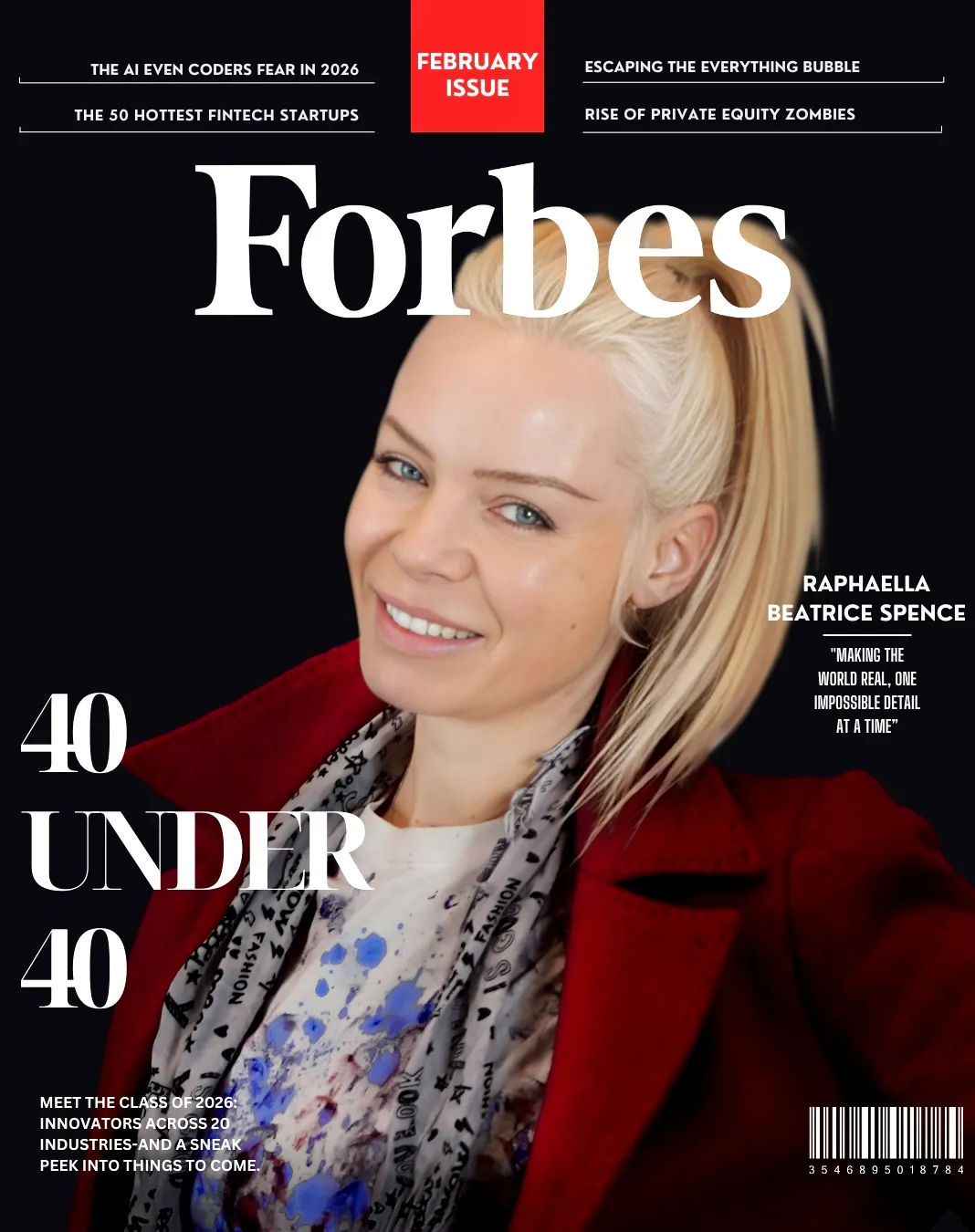
Raphaella Beatrice Spence: Making the World Real, One Impossible Detail at a Time
On a vast canvas in her Italian studio, Superman appears suspended in water, wrapped in crinkled plastic, every droplet rendered with forensic precision. To Raphaella Beatrice Spence, he is not an image but a presence. “For me, these characters are alive,” she says. “As are the canvases.” This conviction, that paint alone can make something breathe, has driven a career spanning continents, museums, and decades, placing her among the leading figures of contemporary hyperrealism.
Born in London in 1978, Spence grew up surrounded by architecture long before she discovered painting. Her grandfather, Sir Basil Spence, was one of Britain’s most celebrated architects, responsible for landmarks such as Coventry Cathedral and the British Embassy in Rome. Her father, architect Milton John Erwin Spence, continued that lineage. Her earliest visual memories were filled with hand drawn plans, architectural watercolours, and conversations about structure, light, and perspective. Long before digital tools, she absorbed a disciplined way of seeing rooted in precision, realism, and spatial harmony.
After an early childhood in France, Spence returned to London in 1986. Her artistic curiosity was already taking shape, fueled in part by small but formative rituals. She recalls special days when her father took her to a fine art shop with creaky wooden floors and the smell of paint thick in the air. “For me, it was like being dropped into a candy store,” she remembers. At home, she painted cautiously, afraid of wasting a pristine pad of paper, already demanding perfection from herself.
At twelve, her life shifted dramatically. Her family relocated to Todi, Italy, where they restored a medieval mill in the Umbrian countryside. The move proved decisive. Surrounded by rolling hills and long summer days, Spence refined her observational skills and patience. She spent hours catching insects, studying their anatomy, and producing extraordinarily detailed ink drawings accompanied by precise biological notes. This meticulous attention to structure, organic rather than architectural, became a foundation for her later work.
Her education was unconventional. She did not attend school in the traditional sense. Instead, she and her brother were among the first students to adopt the UK Open University system, studying at home and sitting state exams as external candidates. The freedom this afforded her was invaluable. While others followed rigid schedules, Spence painted.
By twenty, she was represented by her first gallery in Italy. In 1999, she held her first solo exhibition there, marking the beginning of a rapid professional ascent. At twenty three, she travelled to New York for the first time, arriving with a rolled canvas under her arm to submit to the Louis K. Meisel Gallery. The city overwhelmed her. The skyscrapers, vertiginous angles, and theatricality of the streets felt unreal, “like stepping into Gotham City,” she recalls, especially compared with the hay bales and sunflower fields of Umbria.
In 2003, at just twenty four, Spence made her New York debut with a solo exhibition at the Louis K. Meisel Gallery, formally entering the international hyperrealist movement. She recalls walking into the gallery and seeing, for the first time, all of her work gathered in one vast space. Each canvas bore the weight of hours of painstaking precision. “It was that feeling of, I made it!” she says. That same year, she participated in Iperrealisti, a major museum exhibition at the Chiostro del Bramante in Rome curated by Gianni Mercurio. As part of the exhibition, Spence was the only artist commissioned by DaimlerChrysler to paint the newly launched PT Cruiser, a project that further cemented her international profile.
New York transformed her way of seeing. The cinematic energy and towering architecture stayed with her long after that first visit, pushing her to reimagine the city from above. She began working from aerial perspectives that felt omniscient and otherworldly. To achieve this, she took to the skies. In New York, Las Vegas, Sarasota, Monte Carlo, Zurich, and beyond, she flew repeatedly in helicopters, photographing skylines from seemingly impossible angles. In Sarasota, the helicopter had no doors. Strapped in, she leaned out over the Everglades to capture images that later became monumental canvases. In Zurich, an enthusiastic pilot even allowed her to take the controls briefly, an experience she would later translate into paint.

Between 2003 and 2008, Spence participated in ambitious international projects documenting major global cities, including Prague, Zurich, Monte Carlo, Las Vegas, and Beijing. During the Monte Carlo Formula One Grand Prix, she captured the city at a moment of heightened intensity. During the Chinese Olympic Games, she explored the tension between Beijing’s futuristic skyline and the historic Forbidden City. These works, later exhibited in New York, positioned her alongside hyperrealist figures such as Richard Estes, Chuck Close, Don Eddy, Ralph Goings, and Robert Cottingham, while distinguishing her as the only woman working at the forefront of the movement at that time.
In 2004, she relocated to New York City, continuing to develop monumental cityscapes that fused photographic accuracy with emotional resonance. Even as her career accelerated, eventually encompassing more than one hundred solo and group exhibitions, twenty international museum shows, and works entering major collections, her personal life remained central. Amid what she describes as a “roller coaster of paint and canvases,” she became the mother of three children, now in their teens, whom she considers her greatest achievement and joy.
From 2012 onward, Spence’s influence expanded through a major international museum tour spanning more than fourteen institutions, including the Museo Nacional Thyssen Bornemisza in Madrid, the Birmingham Museum and Art Gallery, Kunsthal Rotterdam, and the Tampa Museum of Art. Between 2018 and 2019, her work reached an unprecedented audience through a large scale traveling exhibition at the Centro Cultural Banco do Brasil, touring São Paulo, Brasília, and Rio de Janeiro and attracting nearly one million visitors.
In 2022, her practice took a decisive conceptual turn. At the Museo Nacional Thyssen Bornemisza in Madrid, she unveiled a body of work that felt both seductive and unsettling. Drawing from her own high resolution underwater photography, Spence turned her lens and then her brush toward the detritus of consumer culture resting on the ocean floor. What emerged were enormous canvases of discarded Coca Cola and Schweppes cans shimmering in jewel toned color. From a distance, the works read as lush abstractions. Up close, logos surfaced. Beauty and devastation became inseparable. In a powerful institutional endorsement, the works entered the museum’s permanent collection.
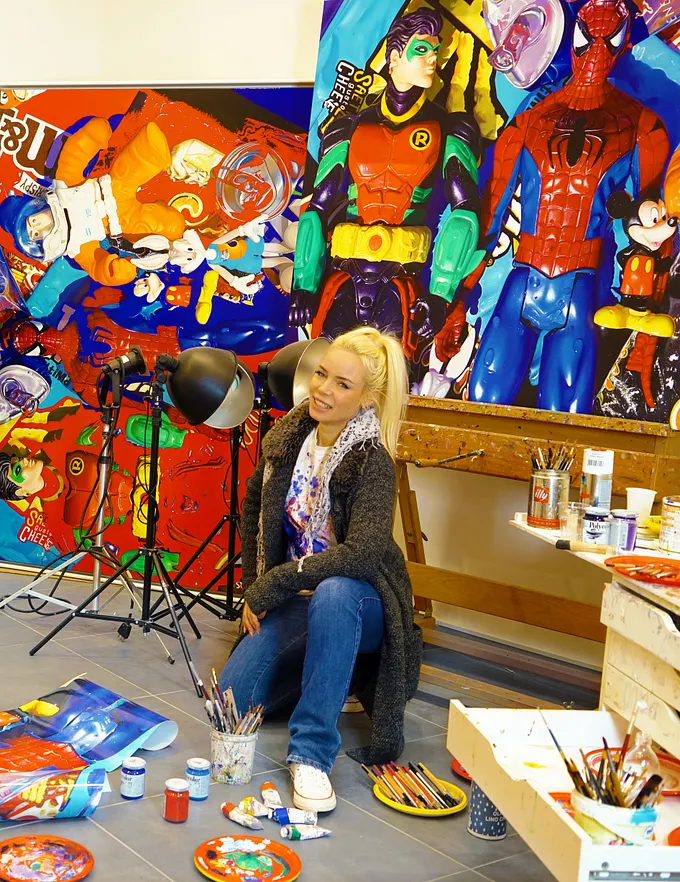
Soon after came her latest evolution. Spence replaced beverage cans with plastic superhero toys suspended in aqueous limbo. Superman, Batman, Spider Man, and the Joker appear monumental yet strangely vulnerable, drifting amid fragments of packaging. Familiar figures from Walt Disney’s animated universe make spectral appearances. Created in her Italian studio, these canvases are feats of near obsessive precision. Every glint of refracted light, every ripple of water, every moulded contour is rendered with exacting care.
These works carry biographical echoes. The superheroes once imagined during solitary walks through New York now resurface transformed. Suspended and stilled, they become emblems of a contaminated world, protectors unable to protect themselves from pollution. In several large compositions, Spence introduces bold interruptions: fields of saturated colour slicing through the aqueous illusion. The effect is graphic and operatic, a collision of comic book immediacy and Old Master grandeur.
With the Plastic Waste series, Spence does not abandon spectacle. She weaponises it. The result is work that feels urgent and unmistakably contemporary, reminding viewers that even our most indestructible myths are made of plastic.
This evolution continues to resonate internationally. In 2024, her work entered the permanent collection of the Parrish Art Museum in New York, becoming only the second piece by a female hyperrealist in the institution’s holdings. She is currently presenting the Plastic Waste series alongside her sweeping New York aerial skylines at the Museum Frieder Burda in Baden Baden, Germany, as part of The Power of Images: Hyperrealism, on view through August 2, 2026. In a singular honour, she was also commissioned to produce a hyperrealist painting of the museum itself, designed by architect Richard Meier.
Since 2005, Spence’s works have been auctioned by Sotheby’s and Christie’s, collected by major museums, and donated in support of causes including the UNHCR and the Italian Red Cross. Today, she continues to work from Italy while maintaining a strong presence on the international museum circuit.
For Spence, the goal has never wavered. “Paint better, paint harder, paint bigger,” she says. “Make the water translucent. Make the reflection real. Just do it. Make it real, with nothing but paint.”