

Hidden Sky Rivers Shape Antarctica’s Ice
Antarctica may seem like a frozen desert, but much of its snowfall depends on invisible “rivers in the sky” carrying moisture thousands of miles through the atmosphere. Now, researchers have discovered that these atmospheric rivers play an even bigger role than previously thought, helping determine how much ice the continent gains each year and influencing future global sea levels.
In a study published in Geophysical Research Letters, scientists from Japan developed a new three-dimensional method to track atmospheric rivers over Antarctica.
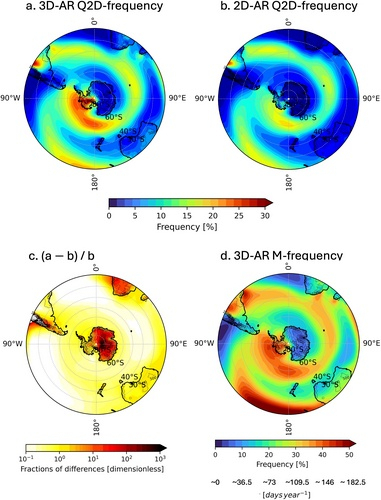
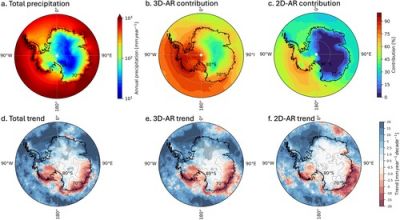
Their findings show that these narrow bands of water vapor are responsible for 30% to 60% of the continent’s annual snowfall, despite occurring less than 10% of the time. In some coastal and West Antarctic regions, they account for up to 90% of yearly precipitation.
The discovery gives scientists a much clearer picture of how Antarctica’s ice sheet is replenished and could improve forecasts of sea-level rise as the planet warms.
What are atmospheric rivers, and why do they matter?
Atmospheric rivers are long, narrow corridors of moisture that transport enormous amounts of water vapor through the atmosphere, much like rivers carrying water across land. They usually form over tropical or subtropical oceans before moving toward cooler regions.
When these moisture-rich systems reach Antarctica, the water vapor condenses into snow, adding fresh ice to the continent’s vast ice sheet.
A useful way to picture them is to imagine a giant airborne river flowing across the sky instead of the ground. Although invisible to the naked eye, these moisture streams can carry more water than many of Earth’s largest rivers.
Because Antarctica stores about 90% of the world’s ice, even small changes in how much snow falls there can affect the continent’s ice balance and, ultimately, global sea levels.
A hidden three-dimensional structure
Detecting atmospheric rivers over Antarctica has long challenged scientists because of the continent’s rugged mountains, extremely dry air and harsh weather.
EurekAlert/University for Advanced Studies, SOKENDAI, Japan
Traditional detection methods treated atmospheric rivers as relatively flat weather systems, making it difficult to capture how they move over the icy continent.
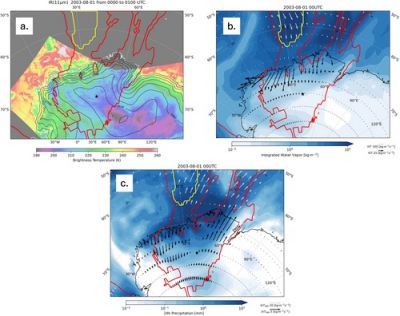
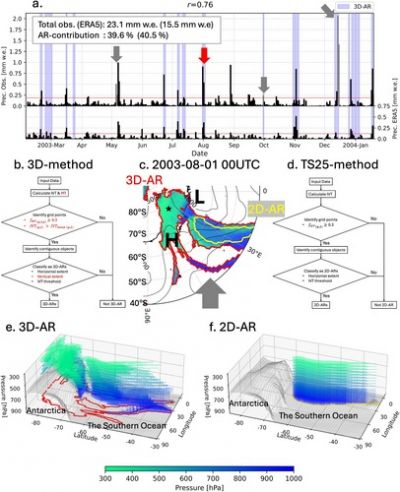
The new study reveals that these moisture corridors are actually tilted three-dimensional structures stretching from the Southern Ocean into higher levels of the atmosphere above Antarctica.
“We found that ARs approaching Antarctica are not vertically aligned as previously assumed but are often tilted structures extending from the Southern Ocean into the upper atmosphere above the continent,” said Kazu Takahashi, a doctoral student at the Graduate University for Advanced Studies (SOKENDAI) in Japan and the study’s lead author.
Because older methods could not accurately capture this tilted structure, they often underestimated atmospheric river activity over Antarctica. The researchers’ new 3D approach tracks moisture transport across multiple atmospheric layers simultaneously, providing a more complete picture.
Why better snowfall forecasts matter
To test the new method, the team analyzed observations collected at Dome Fuji Station in East Antarctica along with satellite data and climate records spanning 1979 to 2023.
The researchers found that atmospheric rivers were linked to more than half of the major snowfall events observed during the expedition period.
“AR-related precipitation accounted for approximately 40% of the total precipitation at Dome Fuji,” Takahashi said.
The broader analysis showed that although atmospheric rivers occur relatively rarely, they dominate much of Antarctica’s snowfall from year to year.
The researchers also found that long-term changes in snowfall closely matched changes in atmospheric river activity, suggesting these systems are one of the strongest controls on Antarctic precipitation.
That matters because snowfall helps offset some of the ice Antarctica loses through melting and glacier flow into the ocean. While warming oceans remain the primary driver of rising sea levels, changes in snowfall can either slow or accelerate the overall loss of ice.
A better view of Antarctica’s changing future
The researchers say incorporating atmospheric rivers into climate models could significantly improve predictions of how Antarctica’s ice sheet will respond to global warming.
1 of 4
agupubs.onlinelibrary.wiley.com
agupubs.onlinelibrary.wiley.com
agupubs.onlinelibrary.wiley.com
agupubs.onlinelibrary.wiley.com
agupubs.onlinelibrary.wiley.com
As Earth’s climate changes, shifts in atmospheric circulation and warming air could alter how often these moisture-rich systems reach Antarctica and how much snow they deliver.
Better understanding those changes will help scientists produce more accurate projections of Antarctic ice-sheet behavior and future sea-level rise.
By revealing that Antarctica’s snowfall depends heavily on these invisible rivers in the sky, the study provides a new tool for understanding one of the planet’s most important climate systems.
Read more
